Even artists who 'hate' Ticketmaster can't avoid it
Published in News & Features
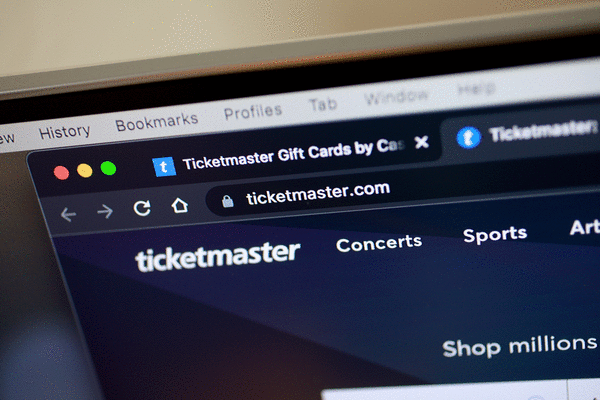
Grammy winning country music star Zach Bryan so disliked Live Nation Entertainment Inc. and its ticket selling unit that he tried to avoid the company’s concert venues on his 2023 tour and even released an album titled “All My Homies Hate Ticketmaster.”
But Bryan still ended up having to perform at some Live Nation arenas on the tour, Jay Marciano, a top executive at rival concert promoter AEG Presents LLC, told a New York jury Monday. Live Nation requires artists who play at its venues to exclusively use Ticketmaster, a service Bryan had publicly criticized over its fees.
“He asked us to find venues he could tour that did not have exclusive ticketing agreements with Ticketmaster,” Marciano said at the trial of an antitrust lawsuit accusing Live Nation of illegally monopolizing the live events industry. While Bryan performed mostly in non-Live Nation arenas on the tour, “we weren’t able to” find any in major markets, the AEG executive said.
On his next tour in 2024, Bryan returned to using Live Nation and Ticketmaster in part because it was more profitable for him than the earlier tour, Marciano said. About 70% of an artist’s compensation comes from touring, he said.
“It would be very difficult to do” a tour without using Ticketmaster, Marciano said.
AEG’s Marciano returned to the stand Monday to finish testimony that began on March 6. The trial, which began March 2, was delayed after the company reached a settlement with the U.S. Department of Justice and a few states to resolve part of the antitrust suit.
But more than 30 states are continuing their case, seeking a forced sale of Ticketmaster and damages on behalf of concertgoers who allegedly overpaid because of Live Nation’s monopoly.
Los Angeles-based AEG operates the world’s second-largest concert promoter after Live Nation, handling about 12,000 shows each year and more than 25 music festivals including Coachella, the popular event that takes place each year at the Empire Polo Club in Indio, California. AEG also owns major arenas, including the Crypto Arena in Los Angeles where the Lakers basketball team plays, and has its own ticketing arm, AXS, that competes with Ticketmaster.
In Europe, where AEG also promotes concerts and sells show tickets, venues often use multiple ticketing companies, Marciano said. For example, in the UK, the venue controls a portion of the tickets while the concert promoter gets to pick where the remainder are sold, he said. Because of that different system, concert fees are lower in Europe, generally around 15%, than they are in the U.S., where the standard is 25%, he said, and venues are able to host more shows.
On cross examination, Marciano acknowledged that AEG, like Ticketmaster, also enters into exclusive ticketing contracts, though he said an “open” model with multiple ticketing services and promoters is better for venues. But he also said no large U.S. venues use multiple ticketers for the same event and none have sought to change to the European model.
In response to questions from Live Nation’s lawyer, Marciano said that artists set the face value of a ticket while the venue sets the service fees. The AEG executive also admitted he’d once called the U.S. concert market “the land of milk and honey” because it’s by far the most profitable one.
Dark Saturdays
After testimony from Marciano, jurors heard Live Nation’s head of U.S. concerts, Robert Roux, say that the company bars third-party promoters from offering shows at venues it owns or operates. That includes clubs, ballrooms and theaters, as well as outdoor amphitheaters with about 10,000 seats which are most popular in the summer. As of 2018, Live Nation operated 42 of the top 50 amphitheaters in the world and has acquired several more since then, he said.
Average spending on an amphitheater concert ticket rose to $133 in 2022 from $101 in 2019, according to a company report presented in court. Those venues generated $386 million in profits for the company in 2024, Roux said.
Still, at its top 10 amphitheaters, Live Nation only hosted shows on half of the Saturdays in the summer of 2018, according to an internal analysis. A lawyer for the states, Josh Hafenbrack, asked Roux whether the company would get more concerts on summer Saturdays if it allowed rivals to host events at its amphitheaters.
Roux said that while it’s possible one or two more concerts might occur if outside promoters weren’t barred, the company doesn’t want rivals using its venues, especially for top performers. “If it’s an artist we would like to do, we’re not going to let somebody compete for that,” he said.
In January 2020, Radio Disney – a now-defunct radio arm of Walt Disney Co. – sought to rent out a Live Nation amphitheater in the Los Angeles area for an event promoted by Superfly, the New York company that founded the Bonnaroo Music and Arts Festival.
Roux wrote in an email at the time that it was “a good deal” because Live Nation analysts estimated the company would make $400,000 for simply renting out its amphitheater. But senior executives nixed the rental because Live Nation wouldn’t be the promoter, with Chief Executive Officer Michael Rapino personally weighing in to say he “would not let them into our venues.”
In response to questions by Live Nation’s lawyer, Roux said it was “not true” that Live Nation withholds shows from venues unless they use Ticketmaster and that artists are never forced to play where they don’t want to. Both Bruce Springsteen and the Eagles are playing at non-Live Nation venues on their upcoming tours that are being ticketed by another provider, he said.
“It comes up on every tour,” Roux said. “You generally don’t look at” the ticketing provider, he said. “You’re looking at where does the band want to play.”
The case is U.S. v. Live Nation Entertainment, 24-cv-03973, US District Court, Southern District of New York (Manhattan).
©2026 Bloomberg L.P. Visit bloomberg.com. Distributed by Tribune Content Agency, LLC.





Comments