Bill Gates turned a blind eye toward Epstein's history, lawmakers say
Published in News & Features
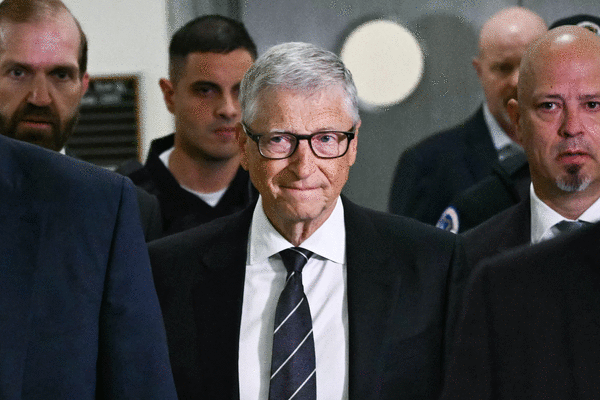
WASHINGTON — Behind closed doors on Wednesday, Microsoft co-founder Bill Gates told lawmakers that his relationship with accused sex trafficker Jeffrey Epstein was one based in strategic networking and the promise of philanthropy.
U.S. Rep. Emily Randall, D-Bremerton, and fellow Democratic lawmakers on the House Oversight Committee, said Gates and Epstein sought to leverage each other’s vast networks of wealth and social capital — and in the case of Gates, turned a blind eye toward Epstein's criminal record to do so.
Gates appeared before the committee Wednesday morning for an hourslong, closed-door interview after a trove of documents released by the Justice Department earlier this year tied the billionaire philanthropist to the notorious sex offender. Epstein, a registered sex offender from his 2008 conviction, was accused of rape and operating a sex-trafficking ring involving young women and girls.
“Some of his answers show us that many of the men who engaged with Jeffrey Epstein only saw what they wanted to see in their interactions,” Randall said during a break in the interview with Gates.
Following the hearing, Gates said in an emailed statement that he appreciated the opportunity to meet with the committee and answer their questions.
"I support the release of all files and hope my participation contributes to getting justice for the victims," he said.
Gates has said that he first met with Epstein in 2011, three years after the New York financier was convicted of soliciting a minor for prostitution, and spent time with him through 2014.
During a Q&A style town hall with Gates Foundation employees in February, Gates apologized for jeopardizing the foundation's reputation over his ties with Epstein. Gates said he and Epstein had met numerous times over a plan for a fund devoted to global health, with Epstein using his Wall Street connections to bring in billions of dollars.
“Gates’ work at the foundation, his interest in public health, his movement of money philanthropically, is the reason he was interested in Epstein’s ability to bundle money and direct money as a philanthropic adviser,” Randall told The Seattle Times. “And I think Epstein knew that, knew that those were Bill Gates’ interests, knew that Bill Gates was powerful, knew that he was an influencer, knew that he was someone he wanted to build a relationship with for his own gain.”
Gates told congressmembers he sought to shore up donor dollars for a vaccine program that the Gates Foundation supported, Randall said.
Gates has since faced intense scrutiny for this relationship with Epstein and the affairs he had with multiple women, affairs that Epstein sought to leverage against Gates. But Gates denied involvement in Epstein’s abusive conduct with women and girls.
"Mr. Gates has said he didn’t see any abuse, and we know that some of the women who were present with Mr. Epstein … were being abused. Maybe not in front of Mr. Gates’ eyes," Randall said. "But we’ve seen men willing to turn away."
Included in the millions of records retrieved from Epstein's estate and released by the Justice Department were photos of Gates posing with women. Gates said in February, while speaking to Gates Foundation employees, that those women never attended his meetings Epstein and were brought in afterward, when Epstein would suggest they all take a photo.
Gates said that outside of taking the photos, he never spent any time with those women, who by his judgment were adults.
"It should have been another weird sign, when he would travel around, he’d always have a couple of these women assistants with him," Gates said of Epstein in February. "They wouldn’t come into meetings with him, but they were there."
Randall said Gates was largely cooperative during congressmembers’ interview. She, like fellow Democrats on the committee, argued the hearing should not have been closed to the public — a decision made by the committee’s Republican leadership.
Rep. Melanie Stansbury, D-New Mexico, said that during the interview Gates justified his relationship with Epstein — despite knowing his reputation — as a means to support his foundation's global health initiative. Gates admitted he knew of Epstein's reputation and his prior conviction, but "ultimately, in his words, he viewed this relationship as being an acceptable means to access wealthy donors, Stansbury said.
Randall said she wants further clarity from Gates about what he saw, and what he chose not to see, specifically pushing him on some of the men he didn't want to name.
Gates did name some individuals in Epstein’s circles that committee members are now interested in speaking with, including people associated with the Gates Foundation, said U.S. Rep. Robert Garcia, D-Calif.
Though Gates' interview was not public, a transcript is expected to be released in the coming days.
_____
(Editor’s note: Microsoft Philanthropies and the Gates Foundation underwrite some Seattle Times journalism projects.)
_____
© 2026 The Seattle Times. Visit www.seattletimes.com. Distributed by Tribune Content Agency, LLC.






Comments