Illinois Gov. JB Pritzker says the Trump's halting of carp project an attack on Great Lakes water
Published in News & Features
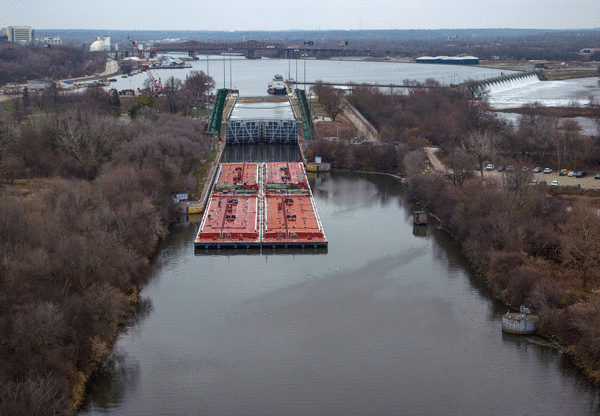
CHICAGO — President Donald Trump’s administration has stopped work on a project to slow the spread of invasive carp in the Great Lakes, a move Gov. JB Pritzker on Friday said amounted to a major attack on Illinois’ and the nation’s freshwater supply.
The comments came hours after the Pritzker administration said it had asked the federal government to reverse its July 24 work stoppage order at the Brandon Road Interbasin Project in Joliet, a project that has gone through fits and starts for more than a year.
“It’s clear that the Trump administration literally is attacking fresh water, clean water, drinking water for the Great Lakes and for the country,” Pritzker said Friday.
The infrastructure project to build defenses against invasive carp at the Brandon Road Lock and Dam on the Des Plaines River has been a major source of tension between Illinois and the federal government, with potentially huge consequences for the region.
Illinois, Michigan and the federal government have for decades tried to stop the invasive fish, which include silver and bighead carp, as they pose threats to existing ecosystems and industries around the Great Lakes. Mistrust between Pritzker and Trump has previously delayed the construction of that project.
Illinois found out about the recent work stoppage “from contractors on site not from federal officials,” according to a statement from the governor’s office. The state Department of Natural Resources sent a letter to the U.S. Army Corps of Engineers requesting a meeting with project leadership, according to the Pritzker administration.
The U.S. Army Corps of Engineers didn’t respond to inquiries Friday.
Trump signed a memorandum last year reaffirming the project while also blaming Pritzker for delays. The U.S. Department of the Interior later froze more than $13.6 million for three other carp mitigation projects in addition to the Brandon Road project.
The Pritzker administration has argued that delays risk both drinking water for tens of millions of people and the regional economy.
Invasive carp, believed to be native to China, were introduced to the United States in the 1960s to control vegetation in aquaculture operations and sewage ponds. Flooding in the 1980s and 1990s allowed the fish to escape into the Mississippi River basin, where they spread rapidly through connected waterways and have since moved north toward the Great Lakes.
Silver and bighead carp pose the greatest ecological threat because they have no natural predators in U.S. waters, allowing their populations to grow unchecked. Their rapid reproduction and ability to outcompete native species for food can disrupt entire ecosystems, making their potential arrival in the Great Lakes especially concerning.
The $1.15 billion mitigation effort at Brandon Road represents decades of coordination among Illinois, Michigan and federal agencies to prevent that outcome. Specifically, the site has been identified as a pinch point where experts hope layered technologies will deter the upstream movement of silver and bighead carp — currently held back by unreliable electrical barriers near Romeoville.
“If it (the Great Lakes water supply) is contaminated by the escape of Asian carp into the Great Lakes, that will diminish our ability to keep that water clean. It will diminish the industries that rely upon the Great Lakes, and all of the states that are bordered on the Great Lakes,” Pritzker said Friday.
_____
©2026 Chicago Tribune. Visit chicagotribune.com. Distributed by Tribune Content Agency, LLC.





Comments