Massachusetts Senate unanimously passes amendment to protect journalists' sources
Published in News & Features
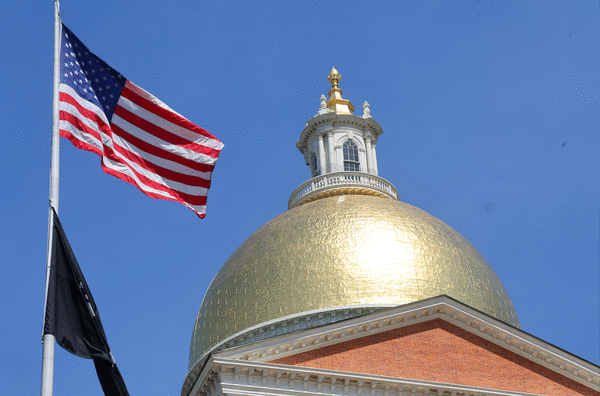
BOSTON — The Massachusetts Senate unanimously passed an amendment Thursday would prohibit government bodies from compelling journalists to reveal their sources as the Bay State remains one of nine in the U.S. without a press shield law.
Amendment 17, added to the Senate’s version of broader public records legislation passed by the House (H. 5469), would protect journalists from being forced to reveal their sources to either state or federal government entities, with exception to specific circumstances.
“No court, grand jury, or judicial, executive, legislative, administrative or other body with the power to issue a subpoena or other compulsory process shall compel a journalist or news organization to testify about, produce or otherwise disclose: (i) the identity of a confidential source of information; or (ii) any information that would tend to identify such a confidential source,” the amendment, filed by state Sen. Rebecca Rausch, D-Norfolk, Worcester & Middlesex, reads.
Can still compel sources
It goes on to state that, if passed, a court could only legally compel a journalist to reveal confidential sources only upon a finding with evidence that there is an overriding public interest in revealing the source, among other measures.
“A court may compel disclosure of the identity of a confidential source or of information that would tend to identify any such confidential source, only upon a finding, after the journalist has been provided notice and an opportunity to be heard, that the party seeking such identity or information has established by clear and convincing evidence that such identity or information is: (i) material and relevant; (ii) critical or necessary to the maintenance of a party’s claim, defense or proof of an issue highly material thereto; (iii) not obtainable from any alternative source; and (iv) there is an overriding public interest in the disclosure,” it continues.
Inspiration
Rausch, as well as several co-sponsors of the amendment, cite actions by the Trump administration against members of the media, specifically citing the administration subpoenaing phone records of New York Times reporters and the FBI raid on a Washington Post reporters home.
“As Trump and his Administration accelerate and intensify their attacks on journalism and sources are increasingly afraid to speak up, the Massachusetts Senate takes an historic stand to strengthen our free press and fortify our democracy,” Rausch said in a press release. “The need for a statutory press shield law in our Commonwealth has never been more urgent. By passing this legislation, we show the federal government and our constituents that we will defend the First Amendment and support a free press, without which our democracy cannot survive.”
But journalists and media organizations have faced similar pressures in Massachusetts to reveal their sources
In 2008, two Herald reporters were subpoenaed to reveal their sources in a Massachusetts murder case after writing about a letter the defendant had sent to his lawyer.
“In order for reporters to function effectively, it is essential that they appear to those they interview and to their audiences as independent of the judicial process,” an attorney for the two Herald reporters said at the time, according to the Reporters Committee for Freedom of the Press.
In 2022, the Berkshire Eagle was locked in a legal battle with the Springfield Diocese to reveal an anonymous source, as was the Boston Globe in another case involving the Dana Farber Cancer Institute.
In the Commonwealth v. Karen Read, the trial court reversed its own ruling on a reporter’s claim of privilege, underscoring the current standard’s unpredictability.
Response
The Senate’s passage of the amendment is also being celebrated by a coalition of groups that includes the ACLU of Massachusetts and the Massachusetts Newspaper Publishers Association.
“This isn’t about giving journalists special treatment — it’s about protecting the public. This law would allow anyone with information about misconduct, corruption, or any other wrongdoing to safely come forward without fear that reporters will be forced to expose them,” said Association President Dan Krockmalnic. “We’re one step closer to ensuring Massachusetts is no longer a national outlier.”
“Massachusetts had one of the earliest constitutional protections for a free press anywhere in the world; John Adams wrote in Article 16 of the Declaration of Rights that ‘the liberty of the press is essential to the security of freedom.’ Today, we are glad to see a new generation of lawmakers embrace that vision by enacting a press shield statute,” added ACLU of Massachusetts Executive Director Carol Rose. “We thank Sen. Rausch, Senate leadership, and the entire chamber for unanimously passing these critical reforms and hope to see them adopted in a final bill.”
Under current state law, Massachusetts courts decide on a case by case basis whether a journalist should reveal a confidential source, weighing a the reporter’s interest in protecting said source against a litigant’s demand for the information. The Supreme Judicial Court has never recognized a reporter’s privilege.
The Senate amendment moves on to the House.
_____
©2026 MediaNews Group, Inc. Visit at bostonherald.com. Distributed by Tribune Content Agency, LLC.




Comments