Commentary: Celebrating another 1776 world-changer -- Adam Smith
Published in Op Eds
Before our celebrations of the Declaration of Independence’s 250th anniversary reach a fever pitch this summer, it might be worthwhile to introduce some humility into the occasion.
In ancient Rome, for example, when a general won a great battle, he was given a triumph — or victory parade. Huge crowds would cheer as the spoils of war were displayed before him, captive slaves were marched, and his victorious soldiers paraded to celebrate their conquest.
Beside the general — adorned with a laurel wreath for his head, and a purple and gold toga to drape over his shoulders — in his four-horse chariot, a slave would stand at his side. His job: to whisper, “Remember, you are but a man.”
This was to protect the general from hubris — pride that tipped into arrogance — and to protect the citizens of Rome from a power-hungry general who might envision himself a dictator.
The Declaration of Independence was no doubt a watershed in human history, but it was many years before its full meaning — and importance — would be clear.
At the time of American independence, several countries controlled more North American land than the United States.
Even after losing the war, the British controlled significantly more land in Canada than the combined area of the 13 original states. Russia held Alaska and parts of the Pacific northwest. And Spain controlled Mexico and colonial Louisiana— each of which was larger than the 13 states combined. (France, which had governed Louisiana from 1682 until 1762/63, controlled it briefly again in the early 1800s).
In short, territorially, the United States was underwhelming in 1776.
It was underwhelming politically as well. The first attempt at writing a constitution, the Articles of Confederation, was a disaster. It already seemed to show, as Alexander Hamilton feared, that the experiment in self-government was destined to fail.
Foreign policy was no better. A ragtag group of pirates from the Barbary States in North Africa captured American ships and enslaved their sailors with impunity. The British seized British-born American sailors straight out of merchant ships and pressed them into British service. And in perhaps the most humiliating event, the British sent troops into Washington, D.C., in 1814 and burned the White House.
When politicians today talk about “Making America Great Again,” the time of past greatness they refer to is not the early years of the republic.
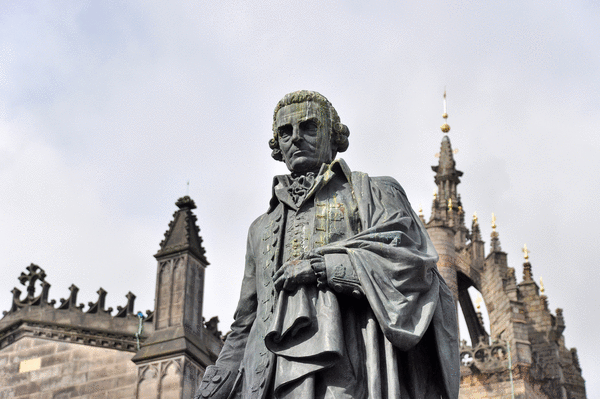
If the future greatness of America was not yet obvious in 1776, another world-changing event took place in March of that year that was immediately recognized for its importance: the publication of Adam Smith’s landmark book, “Wealth of Nations.”
Unlike the American Revolution, Smith’s book was immediately acclaimed as transformative. The first reviews came out almost simultaneously with the book's publication. And the first edition sold out within a few months.
What was so revolutionary about “Wealth of Nations” is that it convincingly showed that wealth is not created by government, but by the productivity of individuals, businesses and industries.
Smith recognized that wealth is not defined by the amount of gold a country possesses, or by its trade surpluses, but by the level of consumption of the country’s citizens.
He also recognized that economic growth comes from the division of labor — you make this, she makes that, I specialize in something else — and allowing people to exchange freely in the market, including international markets. And perhaps most centrally, he recognized the huge social benefits of allowing people to act in their own self-interest. For a country to flourish, Smith thought, it needs to allow its people to be free, politically and economically.
For most of its history, the United States has adopted Smith’s blueprint. According to U.S. News & World Report, the U.S. is consistently at the top of global rankings for entrepreneurship, a strong measure of economic freedom.
Supporting an entrepreneurial spirit is a core American value, and attracting entrepreneurial talent from around the world has been key to America’s success in creating mass prosperity.
As we celebrate the political foundation of American freedom this year, let’s not overlook 1776’s other great champion of freedom, Adam Smith, and heed the lessons he teaches.
____
ABOUT THE WRITER
Frederic J. Fransen is the president of Amerion College in Huntington (W.Va.) and CEO of Certell Inc. He wrote this for InsideSources.com.
_____
©2026 Tribune Content Agency, LLC.



















































Comments