Commentary: Amid political roar, Army keeps its head down
Published in Op Eds
The men and women of the U.S. Army work hard. They work hard at physical conditioning. They work hard at knowing the enemy. They work hard at training for battle.
And these days, they work harder than ever at staying out of politics and focusing on the task at hand.
“Control what you can control,” the Army tells its people. Ignore the noise. Focus on the training, whether that training is on home soil or in Europe alongside fellow NATO forces whose abilities and commitment may come under attack by America’s own commander in chief.
“The training helps give a sense of purpose and a way to bond,” said Master Sgt. Peter Cowley of the 5th Squadron, 4th Cavalry Regiment, 1st Infantry Division, whose unit has trained with German, Polish and other NATO forces. “We don’t talk politics. We are there because we want to fight together and win together.”
The work is not always enough. Some soldiers get declared unfit for duty and left on base when their unit deploys. Some senior officers get passed over for promotion, or fired outright, because they don’t fit a certain profile. Or because they once said something that someone at the top didn’t like. Or because they didn’t say something that someone at the top did like, or they didn’t say it enough, or they didn’t say it with the required enthusiasm.
Tension over Defense Secretary Pete Hegseth’s unprecedented list of promotion reversals has been widely cited as a reason for the resignation last month of Army Secretary Dan Driscoll.
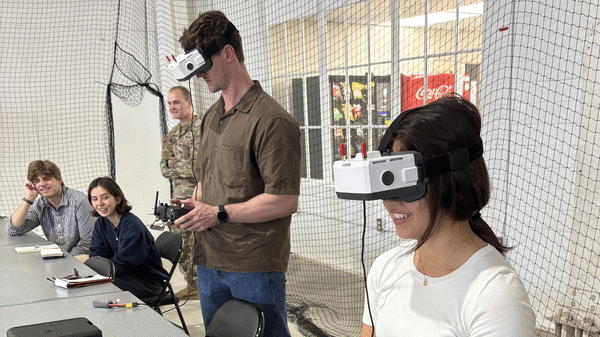
But spend time on an Army base, as students from Northwestern University’s Military Reporting Project did last month at Fort Riley in Kansas, and you’ll come to appreciate the rigor and discipline that Army personnel bring to their jobs.
The four students are part of a new program that aims to bridge the gap between not just journalists and the military but also between the military and America’s civilian population. The student journalists spend their reporting days alongside the soldiers, seeing how they train, watching them prepare for deployment to Europe, breaking bread with them in the chow hall.
As director of the program, an initiative between Northwestern’s Medill School of Journalism and the 1st Infantry Division (“Big Red One”), I worked with the students as they expanded their worldview, built relationships and asked smart questions. (And to be clear, when you are learning about 70-ton Abrams tanks and 120 mm cannons, there is no such thing as a stupid question.)
The students are preparing their own specific stories. But here are some of our high-level takeaways.
The new battlefield: Determined not to be fighting the proverbial last wars (Iraq and Afghanistan, in the case of the United States), the Army is preparing to face Russian and Chinese forces in more conventional large-scale battles.
The officers we spoke to expressed confidence in the Army’s ability to develop weapons and tactics to protect the superiority of American ground forces in the new world of drone warfare and weapons controlled by artificial intelligence. Even senior noncommissioned officers, who can be both the Army’s heart and soul and its harshest critics, put on a brave face.
But the U.S. military is behind on this front. While soldiers at Fort Riley train to use drones for both battlefield surveillance and assault, America lacks the ability to quickly and cheaply turn out the kinds of sophisticated, unmanned weapons that are causing chaos for Russian forces in Ukraine and frustrating U.S. forces in the war with Iran. Just last month, the Army stood down a unit that had been designing and building their own attack drones at a base in Italy.
NATO’s ties with Ukrainian forces are critical here. Their experiences and insights allow American officers to analyze battlefield dynamics in real time and study Russian capacities as they evolve. The Europe deployment offers 1st Division units a chance to war game in countries near or neighboring Ukraine, with similar terrain, alongside NATO colleagues who have become more motivated and accomplished in recent years.
Whether their political leaders get along is a topic the troops try to avoid.
“We have similar attitudes. The humor is the same. We’re all about embracing the suck together,” said Sgt. 1st Class Matthew Meier, also of the 5th Squadron, 4th Cavalry Regiment. “Developing relationships with others is the best part of training. You get more out of your job when you feel more like you are doing something good.”
Deployment on demand: Think about the last time you moved. The planning, the logistics, the cost. Then think about a business having to move and multiply your pain. Then think about an Army brigade with tanks, artillery, aircraft, supplies and people. Lots and lots of people.
We watched as the 2nd Armored Brigade Combat Team readied M1A2 Abrams tanks, Bradley Fighting Vehicles and M109A7 Paladin howitzers and then lined them up to be loaded onto railcars headed to U.S. ports. Ships will ferry them to Europe, and they will ultimately wind up at various Central or Eastern European sites for what promises to be a nine-month deployment.
Why do it? Why not leave some equipment here, there and everywhere and just move the troops around? Because the Army wants each unit to be ready and capable of going where needed, when needed, with its own equipment. Skip the training to do that every time, the thinking goes, and you lose the ability.
Troop readiness and mental health: As much as the military is a unique endeavor, the Army likes to remind people that its members reflect the general population. Substance abuse or mental wellness challenges that we see in civilian life are going to show up in the military as well.
But military life brings its own stressors. And the focus on troop readiness brings a higher level of scrutiny to each individual soldier’s life than might be seen on the outside. So while there are debates about whether the military’s alcohol problem is any worse than it is in society at large, for instance, Fort Riley’s leadership is trying to address the knotty issues of drug and alcohol abuse, loneliness, depression and suicide.
Barracks are being redesigned so single soldiers are less isolated from their brothers and sisters in arms. Physical fitness is now incorporated into a larger wellness program called H2F that includes attention to mental health, nutrition and sleep. The chaplain corps is taking on a larger role to foster spiritual health, and soldiers are responding, no matter their religious or nonreligious beliefs.
The wellness topic, too complex to dive into here, is of particular interest to the Medill students, who share a generation with many of the soldiers we interviewed. We should all look forward to the journalism that comes out of those encounters, and others, as the Military Reporting Project evolves.
____
Colin McMahon, a former Chicago Tribune editor-in-chief, covered multiple armed conflicts as a Tribune foreign correspondent.
___
©2026 Chicago Tribune. Visit at chicagotribune.com. Distributed by Tribune Content Agency, LLC.

























Comments