Trump's call for 10% credit card cap aims at banks' crown jewels
Published in Political News
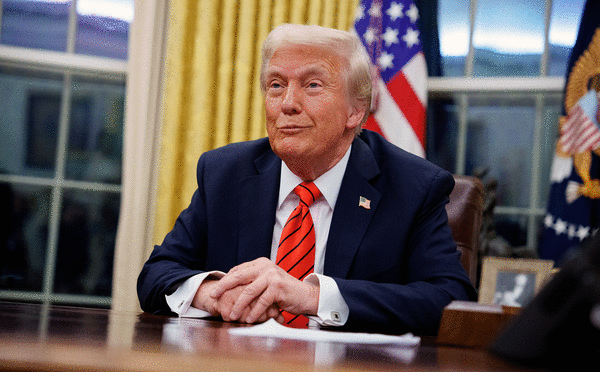
President Donald Trump’s demand that credit card lenders cap interest rates at 10% for a year takes aim at one of the banking industry’s crown jewels — a business line they guard doggedly.
After a week of jarring markets with announcements aimed at making homes more affordable, the president swiveled to another consumer burden: the cost of carrying a credit card balance from one month to the next. This time, his social media missive pushed a slew of card issuers led by JPMorgan Chase & Co., Capital One Financial Corp. and Citigroup Inc. into the crosshairs.
Card interest rates — hovering above 20% in recent years — have become a target of lawmakers on both sides of the aisle, with bills popping up and meeting stiff resistance from the industry. Banking trade groups have conjured foreboding predictions of what would happen if rates were slashed, endangering profitability: Americans on the brink could lose access to credit and be left with payday lenders and pawn shops.
But in response to Trump’s call for rates to drop by Jan. 20, industry groups including the Bank Policy Institute and Consumer Bankers Association struck a more measured tone.
“We share the president’s goal of helping Americans access more affordable credit,” the groups said in a joint statement late Friday. “At the same time, evidence shows that a 10% interest rate cap would reduce credit availability and be devastating for millions of American families and small business owners who rely on and value their credit cards, the very consumers this proposal intends to help.”
For cash-strapped consumers who rely on cards for extra expenses, the cost of carrying a balance can be painful. The average interest rate remained around 21% at the end of last year, according to the Federal Reserve. At that level, paying down $10,000 over three years generates more than $3,500 of interest.
In contrast, the rate on a typical 30-year fixed mortgage — another familiar consumer product — is just above 6%, according to Freddie Mac data.
Banks have long argued unsecured card debt needs a high rate because of the inability to cushion losses when borrowers default: There’s no house or car to repossess. Indeed, after the financial crisis, charge-off rates on credit cards soared north of 10%, while those on residential real estate loans stayed below 3%.
But since then, card lending has become highly lucrative. In 2024, JPMorgan said the net yield on its more than $200 billion in card loans was 9.73%. That drove the bulk of the $25.5 billion of revenue for its card services and auto unit, though the bank also had about $7 billion of charge-offs tied to cards.
After legislative efforts stalled last year, it’s unclear how Trump would force lenders to slash rates in a matter of days, beyond using his bully pulpit.
If a cap were implemented, the impact on banks and consumers would vary widely.
For riskier borrowers, banks would probably have to terminate or significantly retool credit lines, raise minimum monthly payments or tack on extra fees, the Bank Policy Institute wrote in an analysis last year. While it noted the difficulty of making predictions, it said 2019 data gathered by the Federal Reserve indicated a 10% cap would have curtailed credit lines to 14.3 million people and families.
Lenders specializing in that segment would feel it most, according to Himanshu Bakshi, a Bloomberg Intelligence analyst. That could include Capital One, the pioneer of mass-market mailings, Synchrony Financial, a specialist in store-branded cards, and Bread Financial, whose customers tend to have lower incomes than those at major banks.
A credit union trade group called a potential cap “devastating” for its members. “Institutions will not be able to offer credit cards to most consumers at a 10% rate,” said Scott Simpson, the president of America’s Credit Unions.
Other options for dealing with a 10% cap include dialing back rewards and curtailing promotions, such as zero-interest or low-rate periods, the BPI said in its analysis. Banks could also hike annual fees, waive fewer penalties for late payments or boost costs for balance transfers or cash advances.
Banks may be able to make adjustments to lop several percentage points off card interest rates, but slashing them to 10% would erase their margins, said Matthew Goldman, founder of Totavi, a consulting firm to electronic-payment and other financial technology companies.
“A 10% cap would mean the end of credit cards for most consumers except those who need them the least,” he said. For example, “those with very good credit.”
Regulatory whiplash
For bank shareholders, Trump’s abrupt demand may offer a tinge of whiplash. The industry’s stocks have been on a tear, fueled by his appointees’ deregulatory efforts — including dialing back proposed capital rules and stress tests designed to avoid a repeat of the 2008 financial crisis.
The KBW Bank Index tracking 24 major lenders has climbed nearly 40% since his election victory in November 2024, roughly double the pace of benchmark indexes tracking the broader U.S. market. Many banks continued the streak into this year, with senior executives privately predicting an earnings boon from their lending operations.
Rate caps have long been a subject of debate, with differences among state usury laws historically encouraging many banks to set up units in Delaware and South Dakota. Trump has previously waded into the issue and did campaign on reining in card rates, but until now most of the action has been in Congress.
In 2019, Sen. Bernie Sanders, I-Vt., and Rep. Alexandria Ocasio-Cortez, D-N.Y., proposed a 15% cap. Last year, Sanders teamed up with Sen. Josh Hawley, R-Mo., for a bill proposing a 10% limit.
Senate lawmakers even attempted to attach such a cap to the so-called Genius Act, which regulated stablecoins and was signed into law by Trump in July, but the caps weren’t included in the final bill.
Banks have formidable lobbying clout on Capitol Hill, with trade groups representing just about every corner of their industry. When they see a common threat, they can band together quickly and build a coalition of allies. To defeat a Biden-era effort to stiffen capital rules, they enlisted consumer advocates who worried that it could curtail lending.
Last February, after Sanders joined forces with Hawley on their bill, a group of banking trade groups swiftly responded with a joint public letter. Warning that Americans would lose access to credit cards, the group called out the alternatives available in Hawley’s home state.
“One in nine Missourians already uses payday loans, almost double the national average,” the trade groups wrote. “Payday lenders in Missouri charge annual interest rates of more than 300%.”
———
(With assistance from Yizhu Wang, Hannah Levitt and Todd Gillespie.)
©2026 Bloomberg L.P. Visit bloomberg.com. Distributed by Tribune Content Agency, LLC.










































Comments