Where ACC coaches stand on former pro players on college basketball teams
Published in Basketball
CHAPEL HILL, N.C. — Hubert Davis was reflecting Monday night on the 2015-16 North Carolina squad — a group built around versatile ballhandlers Marcus Paige and Joel Berry II — when a lull settled over his weekly radio show at Top of the Hill. He broke the silence with a joke.
“I’d like to have them back,” he said with a laugh. “Maybe we can, with the NCAA rules.”
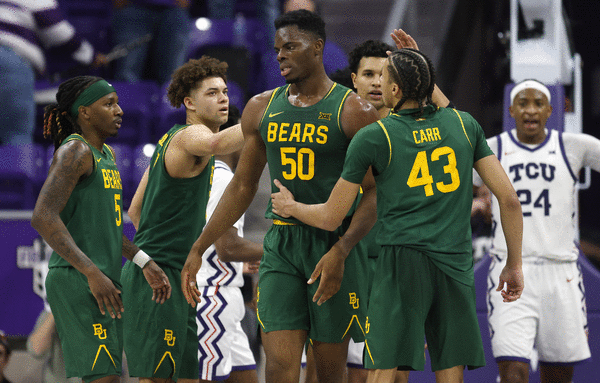
The quip underscores a reality few would have imagined a decade ago. Across college basketball, former professional players — including NBA draftees and one-time G League hoopers — are turning up on rosters (some mid-season), further challenging longstanding ideas about eligibility and fairness. The most notable of these cases was James Nnaji, who became the first former NBA draft pick cleared by the NCAA when he signed with Baylor on Christmas Eve.
Nnaji is part of a growing trend that’s forcing coaches to rethink roster construction, as former professionals — both international and domestic — increasingly view college basketball as an attractive developmental and financial option. The ACC is no different.
Just weeks earlier, Davis declined to comment on programs like Baylor, Illinois and BYU bringing in players from professional ranks, stating it would be “negligent” to comment on “other programs and decisions that they make.” Other coaches in the conference, many of whom addressed the topic during this week’s ACC coaches’ Zoom call, have been more forthright — particularly with the pressure this places on coaches and the impact on opportunities for younger players.
“You’re exhausting every possibility you can to — at the end of the day let’s call it what it is — to get paid,” said Georgia Tech coach Damon Stoudamire on Monday, later adding, “I don’t think it takes away from the game, but it takes away from what we stand for [and] what I thought we stood for at the NCAA.”
Old is gold
Miami’s Jai Lucas is one of the youngest coaches in the ACC, but he’s well aware that age has quietly become one of the most valuable commodities in college basketball. As eligibility rules loosen and roster turnover accelerates, experience — not pure upside — is increasingly the currency that determines how teams are built year by year and how quickly they can win.
“You can kind of see, the thing in college basketball right now, is: How old can you get and can you stay old?” Lucas, the former Duke assistant, said Monday. “[Former pro players] kind of add to that pool as well.”
The data backs him up. According to an analysis by Sportico, the average age for Sweet 16 starters at the 2025 NCAA Tournament was 21.6 — up from 20.8 in 2019. Auburn, the No. 1 overall seed, boasted an average age of 23.3 years among its starting five. Duke’s, by comparison, was 19.4.
Blue Devils coach Jon Scheyer said he felt that age and experience discrepancy this year. He said it’s part of the reason he and other coaches are pushing the envelope to ensure they have the necessary experience on their rosters to be competitive.
“We’re going to play in the ACC [against] 24-year-olds with multiple years of professional experience,” Scheyer said. “I think we’re toward the bottom with experience. I have to make sure we’re smart about how we build a roster that way depending on how the rules adapt and change.”
NCAA guardrails and the gray area
Clemson coach Brad Brownell bookends Lucas as the ACC’s most tenured head coach. He said the most frustrating part of the current landscape — particularly former professional players joining the college ranks — is a lack of transparency.
“I think the frustrating part for coaches is that most of us were unaware that this was even a possibility — that some of these guys could possibly be eligible,” Brownell said Monday. “Some of these coaches pushed the envelope a little bit and did some more research and figured it out. But I just think when everybody isn’t on the same page … that’s when it’s really problematic.”
Mark Madsen, a two-time NBA champion who’s been the head coach at Cal since 2023, said he’s in favor of coaches finding “any opportunity they can to make their team better.” But he also noted the “rules are in flux right now.”
“We’ve gotten clarity on some things, but there’s a little bit of gray right now in terms of what exactly is allowed and what is not,” Madsen said Monday. “I think, from what I’ve heard, players can make a lot of money overseas and still be eligible in the NCAA. The gray is how much eligibility they will have remaining.”
The NCAA has tried to draw lines since the news of Nnaji’s signing. That included a statement from president Charlie Baker on Dec. 30 that players who sign NBA contracts, including two-way deals, are ineligible.
Baker emphasized in his statement that the NCAA has “long permitted” schools to play individuals with no prior college experience midyear.
“As schools are increasingly recruiting individuals with international league experience, the NCAA is exercising discretion in applying the actual and necessary expenses bylaw to ensure that prospective student-athletes with experience in American basketball leagues are not at a disadvantage compared to their international counterparts,” Baker wrote in his statement.
But many coaches, like Stoudamire, are still seeking more clarity.
“Pandora’s Box been opened with that,” Stoudamire said Monday. “And so there’s just so much stuff that I don’t really know, and I don’t think a lot of us really know. We just kind of got to play with the parameters that were given to just move forward.
But, you know, I’m not mad at the kids for doing it. I’m just mad that there’s no guard rails with the rules.”
‘Pushing the envelope’
The ACC is no stranger to recruiting players with international professional experience — particularly in the Triangle.
For the third time in four years, Duke brought in a key recruit from overseas: Dame Sarr of Spain’s FC Barcelona. UNC has three international players, including starters Henri Veesaar and Luka Bogavac. Both Bogavac and N.C. State’s Musa Sagnia are 22-year-old college newcomers. Sagnia, who played professionally in Spain before joining the Wolfpack, is listed as a freshman.
Several ACC coaches expressed concern about the ripple effect this trend will have on the traditional 18-year-old freshman.
“Those guys are gonna lose some opportunities,” Brownell said. “I’m certainly not against international players coming and playing in the United States. I just don’t know that there’s a way to properly vet all that. … I just have a little concern with that and taking away opportunities from traditional 18-year-olds.”
Madsen echoed this sentiment, but said high school recruits will “find a way,” likely by opting for a lower-level school to start their college career and working their way up via the portal.
This might not be the way things operated in the past, but coaches like Madsen, Scheyer and Lucas all emphasized the need to adapt quickly — even if that might mean adding a player who heard his name called at the NBA draft just a few years earlier.
“There continues to be the next step of pushing the envelope of what can and can’t be done,” Scheyer said. “As a coach, you have to ask: Where’s that line? How do you make the decisions that best represent your school and give you the best chance to win?”
©2026 Raleigh News & Observer. Visit newsobserver.com. Distributed by Tribune Content Agency, LLC.






Comments