Emotional, creative protests rise up in Mexico City ahead of historic World Cup opener
Published in Soccer
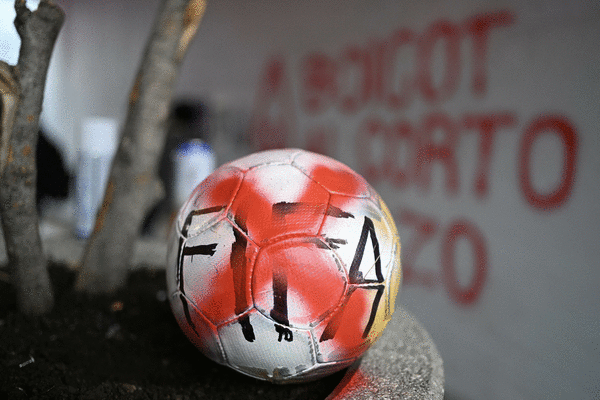
MEXICO CITY — The star-studded opening ceremony for the 2026 World Cup will unfold Thursday afternoon in Mexico City.
The Mexican capital joins Guadalajara as the only cities to host games during three editions of the World Cup. Shakira will headline the pre-match spectacle alongside Mexican music stars Alejandro Fernández and Los Ángeles Azules.
Fans who paid thousands of dollars for tickets will then cheer on the Mexican team as it faces South Africa at Azteca Stadium, opening an ambitious tournament co-hosted by three countries.
But in the streets outside the historic stadium where soccer legends Pelé in 1970 and Diego Maradona in 1986 delivered iconic plays, other voices are rising as loud as the cheers.
Ana Laura Velásquez Delgado, who searched for her son Jesús for nine months until an independent group informed her that it had found his body in a grave alongside 12 other people, is among those who have wept, chanted and shouted in protest during the week leading up to the World Cup.
“We’ve been asking for justice for four years,” said Velásquez Delgado, a native of Toluca. She said the depression caused by her son’s death led to her husband’s recent death.
“If all the money Mexico is spending on this event were instead spent on searching for our children the way we search for them, it would make a big difference,” said Velásquez Delgado, whose son’s remains were found 14 miles from the Toluca stadium where Mexico played its final pre-World Cup exhibition match.
Velásquez Delgado is one of thousands of women who have joined various groups using the World Cup as a platform to raise awareness about Mexico’s missing residents. Relatives of missing Mexicans have been joined by teachers, farmers, transportation workers, animal rights activists and sex workers, whose demands range for better wages and pensions to attacking the lack of services for citizens to denouncing evictions that have left workers without homes.
Protesters have been steadily gathering for a week ahead of a massive protest planned for Tlalpan, near the Azteca Stadium on Wednesday night ahead of the first match. The venue has changed title sponsors and is officially called Banorte Stadium or Mexico City Stadium during the World Cup, but Mexicans continue to refer to it as Azteca.
Rallies are also planned the day of Mexico’s opening match in Mexico City’s Zócalo, the popular gathering space in the capital where the game will be broadcast on screens for thousands of people.
“We want to highlight that Mexico is facing a crisis of disappearances and also a crisis of impunity,” said Jorge Verasteguí González, who has been searching since 2009 for his brother, Antonio, and his nephew, Antonio Jr., who disappeared in Coahuila.
“Possibly, because of its involvement with organized crime, the government does not want to investigate those responsible,” added Verasteguí González, who suspects that both relatives were victims of Los Zetas cartel and travels throughout the country to participate in demonstrations.
Mexico City’s World Cup promotional campaign, “The Ball Returns Home” — a reference to the sport played by the Aztecs, Mayans and other Mexican indigenous communities as well as previous stints hosting the 1970 and 1986 World Cup tournaments — has been reinterpreted by activist groups, who have hung banners along bustling Paseo de La Reforma that read: “The Ball Returns Home — When Will Our Children?”
In Guadalajara, another World Cup city that will host its first match featuring South Korea and the Czech Republic on Thursday night, groups such as the “Light of Hope Collective” have arrived to push missing people into the spotlight. In addition to protesting in the streets, they made their version of World Cup trading cards go viral. Instead of displaying Mexican soccer team players’ faces, the group’s cards feature the faces of missing relatives atop the Mexican national team’s uniforms.
Mexico President Claudia Sheinbaum has focused on distinguishing between disappearances committed by organized crime and those forced by state agents. Sheinbaum has said her administration has met with families of the disappeared and that they have been effective in eradicating the corruption that existed within the state that led to thousands of disappearances two decades ago.
But many remain unconvinced that the issue has been resolved, arguing many are still missing and others are at risk of being kidnapped.
Teachers speak out
Groups of teachers and their unions have blocked highways, torn down World Cup symbols and occupied the Zócalo to demand better working conditions, including pay raises and the restoration of a public pension system.
Fausto Enríquez García, a teacher and secretary of Section 22 of the National Union of Education Workers (SNTE), traveled from Oaxaca to launch the movement that began in his state on May 25 and represents more than 16,000 teachers.
Enríquez García said that, although teachers face criticism on social media and some label them “lazy teachers,” they are fighting for a dignified and just life.
“It is a struggle between the bourgeoisie and the workers, but also, as human beings, we have the right to live with dignity,” said Enríquez García, who noted that they are not opposed to soccer, but rather oppose the companies that have “taken soccer away from the people.”
The protests, held in the rain and at encampments along the route to the Zócalo have claimed the life of one teacher and left another seriously injured. Teacher Ignacio Ismael died on May 26 after suffering health complications while at the encampment near the historic center. In the week leading up to Thursday’s game, teacher Proceso Columbo González lost his left eye after being struck by a rubber bullet during clashes with police near the Zócalo.
The teachers’ anger was evident when footage circulating on social media this week showed protesters toppling giant soccer player figures installed for the World Cup, storming a government building and on Friday staging a soccer match on one of the city’s main avenues, causing traffic chaos as the first World Cup visitors were beginning to arrive for a tournament kickoff party.
“We don’t know if they are teachers or a group looking to provoke,” Sheinbaum said Friday during her morning press briefing. “We’re not going to remove them because that’s exactly what they’re looking for.”
Sheinbaum said fences will be installed to prevent confrontations between police and protesters in the Zócalo. On Thursday during Mexico’s match, access about a mile around the stadium will be limited to those with tickets.
Box seat owners take legal action
Another group plans to protest on the day of the World Cup opener: the owners of Azteca Stadium box seats.
One of Roberto Ruano Ortega’s most vivid memories with his father was watching Pelé at the 1970 World Cup from the stands of Azteca Stadium. In 1975, his father acquired the rights to a box seat at the stadium for 99 years. Since then, the family has watched concerts by Michael Jackson and Elton John, a visit from Pope John Paul II, Julio César Chávez’s victory over Greg Haugen, NFL games and Diego Maradona’s famous “hand of God” goal scored during the 1986 World Cup.
Days before the opening match, Ruano Ortega finally managed to secure his 2026 World Cup seats. According to the current contract with the stadium, box owners have the right to attend all stadium events, rent out their seats and bring in outside food. According to Ruano Ortega, neither the stadium nor FIFA is allowing them to exercise those rights.
“It’s an abuse, a lack of respect,” said Ruano Ortega, spokesperson for the box owners’ association. “FIFA, the stadium and no one else is above Mexican law. We’re going to demand that it be respected.”
When FIFA accepted the Azteca Stadium as a World Cup venue, it was not informed of the restrictions imposed by the box and general admission seat contracts. The contracts apply to 15,000 private seats: 9,000 in boxes and 6,000 in general admission sections. Each box owner has about 10 seats that can be transferred, rented out or bequeathed.
During the past two years, box owners have been in a dispute with stadium administrators over their rights to their seats during the World Cup.
The association has filed a lawsuit in federal court to secure access. On match day, some owners plan to enter the stadium accompanied by a notary public and a court order to avoid arrests or fines.
FIFA and the management of Mexico City Stadium, Grupo Ollamani, have not yet responded to requests for comment about the dispute.
Unfinished construction projects
Mexico City Mayor Clara Brugada Molina announced that the World Cup will leave behind more than 2,000 completed construction projects in the city.
There are still numerous construction projects throughout the city, however, that appear far from being finished — especially at metro stations.
“We are going to leave a sporting legacy, with more than 500 fields being used and enjoyed by the public,” said Brugada Molina, who has faced criticism for announcing improvements to some metro lines, including the installation of lighting on certain lines, that clearly haven’t been completed.
Lizete González, a Mexico fan, said the city has a long way to go to fulfill its promises.
“We aren’t ready for the World Cup,” said González, who, despite her disapproval of her government, supports the Mexican soccer team. “We don’t have the infrastructure. Everything has been done on the fly.”
____
©2026 Los Angeles Times. Visit at latimes.com. Distributed by Tribune Content Agency, LLC.




Comments