Judge gives federal government 2 weeks to explain incomplete Renee Good shooting evidence
Published in News & Features
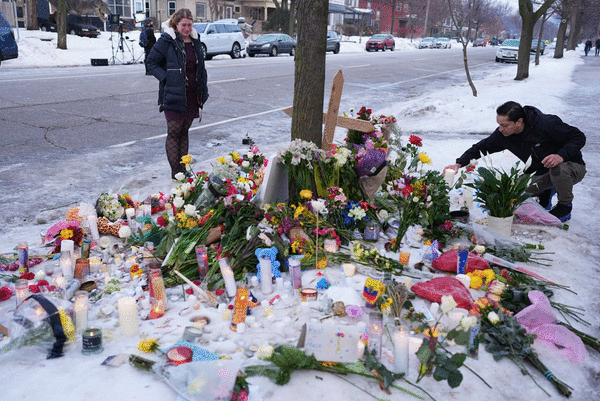
MINNEAPOLIS — A federal judge says the federal government has fallen short in turning over a complete trove of evidence from the shooting death of Renee Good by ICE agent Jonathan Ross, following her order in a tangential case.
U.S. Magistrate Judge Shannon Elkins wrote in a court filing that the government has only partially complied with the court’s demand to hand over evidence tied to Good’s Jan. 7 shooting. She gave the U.S. government two weeks to explain why the submission is incomplete.
The requested evidence from the shooting stems from the criminal case against Roberto Carlos Muñoz-Guatemala, who was convicted of dragging Ross with his car last year in a traffic incident in Bloomington. In April, a federal judge ordered the Minnesota U.S. attorney’s office, Department of Homeland Security and U.S. Immigration and Customs Enforcement to hand over a trove of evidence from the killing of Good for the court to review for relevancy ahead of Muñoz-Guatemala’s sentencing. Good was driving an SUV when Ross shot her.
The order comes just weeks after Minnesota officials announced an apparent breakthrough in their own efforts to compel the U.S. government to hand over evidence in the shootings of Good and Alex Pretti during Operation Metro Surge so the state can conduct an investigation. After the state’s initial attempts to conduct a joint probe into the shootings were thwarted by the Trump administration, Hennepin County Attorney Mary Moriarty announced that the Justice Department had quietly turned over a significant amount of evidence in the shootings. The evidence included the SUV that Good was driving when she was shot, as well as hard drives of evidence such as body camera footage and statements from immigration enforcement agents about the killings. The Justice Department has continued to remain quiet about the agreement.
In Muñoz-Guatemala’s case, Elkins said the U.S. government repeatedly claimed that the missing records either did not exist or could not be obtained. Elkins gave the U.S. government until Aug. 14 to file its affidavit with details of what attorneys did to obtain the documents.
Elkins asked the U.S. government to explain gaps in the evidence, which she identified as:
—Ross’ personnel records. Elkins said prosecutors have turned over the training and personnel file for Ross for the duration of his employment, but said the documents referred to “originating documentation” that was not attached.
—Use-of-force and shooting policies. Elkins said the court has only received use-of-force handbooks from ICE’s Enforcement and Removal Operations dated from 2022 and 2021. She asked the government to show their efforts collecting Homeland Security’s use-of-force policies regarding officer shootings and the proper use of force that were in effect June 17, 2026.
—Statements by Ross and witnesses. Elkins asked the government to explain their efforts to get calls, messages and statements made by Ross before the shooting, during the shooting and in the months afterward. Elkins added that the court also couldn’t tell if any witnesses to Good’s shooting were identified or interviewed by the U.S. government.
—Medical and fitness records. Elkins asked the U.S. to detail its efforts finding all medical examinations of Ross, including breath, blood and drug tests, done as a result of the Jan. 7 shooting.
—Video, audio and photographs: Elkins said she’s concerned with the lack of photo, video and audio evidence from federal agencies, including any evidence from cameras within government vehicles or from body cameras in the moments before the shooting and after. She ordered the government to explain which agencies the attorneys contacted for the information and their response.
—Statements by Muñoz-Guatemala: Elkins said the court hasn’t received any statements Ross made about his encounter with Muñoz-Guatemala. The government was asked to explain what was done to collect the information.
The Minnesota Star Tribune contacted the U.S. attorney’s office for comment about the judge’s order.
Eric Newmark, Muñoz-Guatemala’s attorney, said the order speaks for itself.
“Unfortunately, the government, according to the magistrate, has not complied with the court’s order and that would fit a pattern ... just in general, of the federal courts demanding things of the government and the government not complying,” Newmark said.
_____
©2026 The Minnesota Star Tribune. Visit startribune.com. Distributed by Tribune Content Agency, LLC




Comments