Before the final midterm whistle, Senate spends time on sports
Published in News & Features
WASHINGTON — The last thing the Senate does before the midterms could be a bill on college athletics. It’s been on the to-do list for a while, but as senators think about their closing message ahead of the election, not everyone is sure it’s the best call.
Many Republicans blame Democrats for not playing ball on anything else, pointing to the sweeping cryptocurrency package that went down earlier this week or a blocked attempt Thursday aimed at addressing voter anger over data centers.
But others say their party should be doing more to address issues like affordability and, more recently, the rising threat of artificial intelligence.
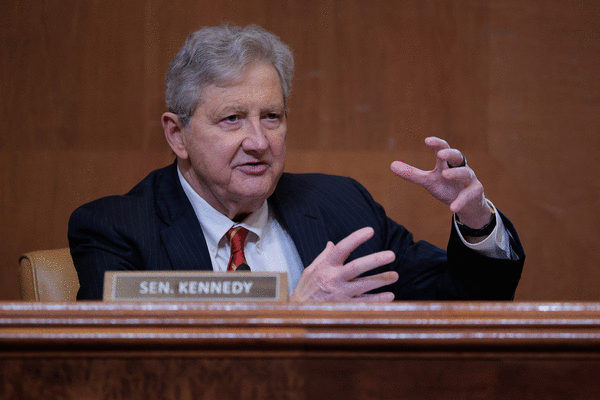
Sen. John Kennedy, R-La., said Thursday, “I think we’re going to make the football coaches happy and then go home. That’s what my prediction is. I’m not saying that I’m happy with that. I’m actually not.”
“I’ve said since we passed the One Big Beautiful Bill that we ought to be doing something to address the cost of living. We haven’t,” he added.
Diesel prices, which affect everything from trucking to food costs, have soared past $6 a gallon to record highs, according to AAA, up from about $3.76 in late February.
The cost of living remains a top concern for voters amid the ongoing war in Iran — which has cost the Pentagon $38 billion and counting — and President Donald Trump’s willingness to impose new tariffs. The Federal Reserve on Wednesday raised interest rates for the first time since 2023.
Sen. Josh Hawley, R-Mo., said it “would certainly be an interesting choice” if the Senate left town after dealing with the college sports bill without addressing affordability. “I mean, right now, the crisis is nobody can afford their gas, and farmers can’t afford to run any of their machinery,” he told reporters.
Neither Hawley or Kennedy are up for reelection this year. But Hawley said as candidates face questions on the campaign trail about energy prices, he wasn’t sure what they were going to say. He said he believes “we should not leave here until we vote on suspending the gas tax to bring down gas and diesel as much as we can, as quickly as we can,” noting the pressure on American farmers, who have historically been politically loyal to the GOP.
“It’s tough for them right now. And Congress should do something,” he said.
But fierce partisanship ahead of the midterms has made it hard to get anything done. And the House called it quits even earlier than anticipated this week with no plans to return until November.
Sen. Thom Tillis, R-N.C., said, “We’ve got the National Defense Authorization Act. We’ve got the farm bill. We’ve got the crypto bill. We got a lot of things that we should pass out because, frankly, we never know when the House is going to be in session.”
“It’d be nice to get a lot of stuff in their inbox before we get out of here so that we have a prayer of getting it ratified before the end of Congress,” said Tillis, who is retiring at the end of this term.
Senators are also eyeing a deal on an energy infrastructure permitting overhaul, but a bipartisan agreement has yet to emerge.
Some Republicans up for reelection have their own priorities they’d like to see move forward. Sen. Susan Collins, who is in a tough race in Maine and has never missed a Senate vote, told reporters this week that she wanted to see action on her insulin cap proposal.
Still, Sen. Pete Ricketts, R-Neb., who is also protecting his seat this November, said, “I can tell you that college sports is very important in Nebraska, and people do care about getting the NIL issue fixed, so that we continue to have robust women’s and men’s sports.”
“We always need to be working more on” affordability, he said, but Republicans have “done a lot to put money back in people’s pockets.”
‘The biggest issue’
The bill aimed at calming college athletics’ chaotic name, image and likeness era — known as the Protect College Sports Act — has the backing of President Donald Trump and bipartisan support.
Led by Senate Commerce Chair Ted Cruz, R-Texas, and ranking member Maria Cantwell, D-Wash., it rose to the top of the list as hopes for even more ambitious items dimmed. Trump had pushed for another reconciliation package before the midterms to pump up defense spending and boost voter ID policies, for example, but no quick path for that existed in the Senate, as Majority Leader John Thune, R-S.D., repeatedly made clear.
If senators can push the NIL bill through the Senate in the coming days, the next task will be connecting the dots with voters. People “who are struggling” are not “lying there worried about whether the NCAA needs an antitrust exemption. That’s just not on their scorecard,” Kennedy said.
Among those who voted against proceeding to the bill this week was Sen. Rick Scott, R-Fla., who said, “I think we ought to be doing something on affordability” instead.
Scott, whose name has swirled in presidential speculation for 2028, rolled out an economic platform this week rooted in fiscal responsibility that he will share at various events around the country. But the former chair of the National Republican Senatorial Committee still sounded upbeat about the chances of keeping the chamber come November, where Republicans cannot afford to lose more than three seats.
“Jobs are coming back,” he said. “Trump has driven down fentanyl deaths, murder rates, the border is secure. We got a lot of stuff to run on. The Democrats have gone crazy. They’re all socialists.”
According to some polls and forecasts, Democrats are neck-and-neck or gaining steam in key races. As senators met with South Carolina underdog candidate Annie Andrews at the Democratic Senatorial Campaign Committee headquarters on Wednesday, they expressed optimism about their chances of expanding the map, even in the long-shot territory of traditional Trump country.
And their messaging homed-in on affordability.
“It makes sense for us to be everywhere,” Sen. Peter Welch, D-Vt., said. “There’s an enormous drag on the Republican side because the Trump tariffs, his disregard for the affordability issues — he’s calling that a hoax. That’s really hurting people.”
Sen. Andy Kim, D-N.J., said he was feeling energy on the ground in unexpected places. As “somebody who won a [House] district that Trump won, I remember in September 2018, people didn’t think my district had a shot.”
Many Republicans are pointing their fingers at Democrats for blocking several pieces of legislation from moving forward this work period. That includes the crypto package known as the CLARITY Act, which fell short, 49-50, on a procedural vote Tuesday after months of bipartisan negotiations, as well as Senate Energy and Natural Resources ranking member Martin Heinrich’s objection Thursday afternoon to Sen. Jon Husted, R-Ohio’s, unanimous consent request for what’s dubbed the Ratepayer Protection Act.
Heinrich, D-N.M., said the House-passed bill was insufficient because the new standards for data centers would be voluntary.
Thune posted to X: “With affordability concerns front and center for the American people, it’s unfortunate — but not surprising — to see Senate Democrats block” the ratepayer bill.
On Thursday Thune said “it depends” when asked if there is time to do a roll call vote on the ratepayer bill, noting the time it will take to get through the college sports bill next week and that it would take cooperation from Democrats to speed things along.
“Right now, everything is a time crunch and we have a lot of members, I’m sure like a lot of Democrats, who want to get out on the campaign trail,” he told reporters.
—Kelly Livingston, John Donnelly, John T. Bennett and David Jordan contributed to this report.
©2026 CQ-Roll Call, Inc., All Rights Reserved. Visit cqrollcall.com. Distributed by Tribune Content Agency, LLC.




Comments