'The nicest situation I could ask for': Why young some adults are opting to live at home
Published in Lifestyles
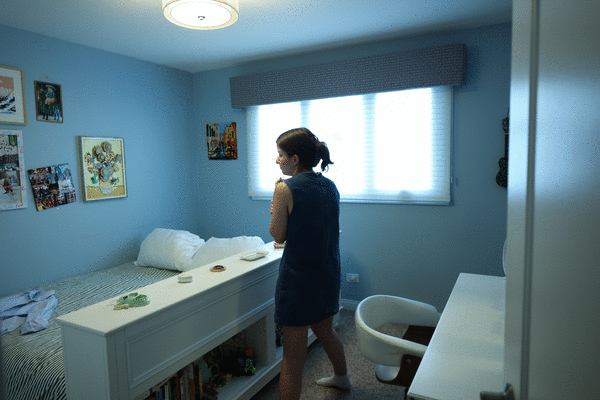
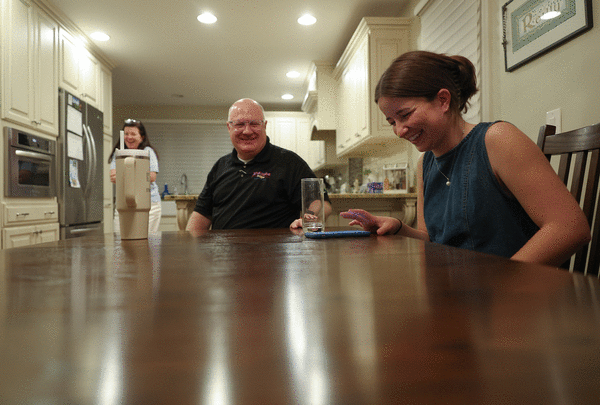


CHICAGO -- Mary Kate Reilly’s after-work routine is familiar and comforting. Her 50-minute commute ends at her childhood home in Tinley Park, Illinois, where her mom is waiting when she walks in; she shares a meal and relaxes with her parents afterward as they watch reality TV.
It’s a living situation the 23-year-old did not exactly envision for herself when she graduated with a degree in environmental design last year. Still, it’s one she’s thankful for these days as she navigates early adulthood.
Reilly’s arrangement reflects a prevalent pattern in Gen Z: moving home after graduation. There are a myriad reasons. Most commonly, it makes financial sense to pay discounted or no rent in today’s economy.
It’s a decision nearly 60% of Americans between the ages of 18 and 24 are making — or are forced to make — to live with their parents, according to a June Realtor.com report. That trend is echoed across Chicagoland, where rent prices have surged in recent years. In the city’s neighborhoods and the suburbs, several young adults told the Tribune their main motivation for returning home was financial.
Cohabiting with parents or relatives comes with plenty of perks. There’s familiarity, shared housework, emotional support and the chance to build a fresh, adult bond with the people who raised you. Many say their parents are so happy they’ve returned home; it’s even better than before they left. Others point out that living with family is a surefire way to avoid signing a lease with strangers or a roommate who doesn’t mesh with your personality or daily routine.
“It’s hard to not feel like, not frame myself as struggling,” Reilly said. “But my parents are always like, ‘We’re going to get so much older, and you’re going to look back, and you’re going to be like, ‘Oh my God, that was so much fun that we got to spend so much time together.’”
It’s been a year since Reilly’s return, and she’s since found her footing in the interior design field. And while there’s no set time, she plans to move out eventually. In addition to the money she’s saving and the quality time she enjoys with her parents, she’s grateful for the support and cushioned space to find a job she really likes. It’s “the nicest situation I could ask for,” she said.
The feeling is mutual for her mother, Kathy Reilly, who said it’s fortunate and special to support her children, including giving them the chance to come home and explore postgraduate opportunities before deciding.
“The least resistance you should have is from the people that love you the most,” Kathy Reilly said. “You should have that soft landing and feel safe in and with the people that raised you.”
It does take a bit of getting used to. For Reilly, the move home sparked a slew of internal comparisons with her peers and questioning her own lifestyle, including the realization that the standards she set for herself postgraduation were unrealistic.
“I don’t feel like people judge me for living at home … but it’s definitely a feeling of: When is it going to change?” Reilly said. “Obviously I want it to and it’s going to, but it’s just a lot of timeline pushes of: Well, what are you doing to get out of your situation right now, or how are you moving towards moving out on your own? Am I not doing enough, or am I saving up enough?”
Hayden Castle, 25, has a similar story: He initially attended college in Iowa but returned home to live with his parents in Oswego after the COVID-19 pandemic. For Castle, who recently graduated from Aurora University, staying home helps him learn skills including budgeting and time management before he needs to apply them in real life.
Castle had strong examples of multigenerational living long before becoming an adult. His family moved in with his grandparents when he was a child, which forever frames living with parents as a positive thing.
“I think from an early age, I understood that family is here to help you and it’s not something you really have to look down upon, or it’s not something to be ashamed of, living in a house with your grandparents and other family,” Castle said.
And even though he has similarly battled feelings of shame and not being on the right path for his age group, having his family around him has helped.
“Everyone’s on their own pace,” he said. “Just because some people are finishing school a year early and they’re graduating at the age of 20 from college doesn’t mean that you’re going to be any less successful.”
Castle’s frame of mind is a good one, according to TeraKesha Hammond, a Chatham-based licensed clinical professional counselor. The decision to go back home doesn’t necessarily mean “a failure to launch,” she said.
Hammond works with clients in her practice to highlight their successes, especially as higher education and living costs have risen. Setting short-term and long-term goals that coincide with the values you set for your life is a good way to not lose sight of your aspirations during your stay at your parents’ home.
“Society says the American Dream is to own a home, go to college. … People are redefining that dream,” she said. “What I do in therapy is help people find what is good for them. I do think that returning home is a strategic step in finding greater financial, emotional, and long-term stability.”
Over 40 miles away, Vincenzo Bono’s work routine starts early and rarely wavers. The 22-year-old University of Illinois Urbana-Champaign graduate wakes around 6:45 a.m. every day to catch the Metra train from Franklin Park into Union Station, dropping him right next to his office. After work, he comes home, goes to the gym, eats, and relaxes by hanging out with friends in person or online.
Peppered into his routine is his grandmother, whom he lives with — daily “good mornings” said to each other, dinner eaten together, and conversations about their days shared between them.
For Bono, living with his grandmother is appealing for multiple reasons: the home-cooked meals and the financial savings he’s seeing. He plans to live with her for the next two years as long as he doesn’t change jobs, he said. He knows people who say they are getting apartments just outside the Loop after they graduate from college. “I’m like, ‘That’s crazy. That’s like $2,000 a month. You’re really not willing to take the train a 30-minute commute (and instead) drop $2,000 a month?’ But I mean, that’s their choice,” he said.
Living together benefits Bono and his grandmother, for whom he said it’s helpful to have someone else around. Their home holds happy childhood memories.
“I spent most summers with my grandmother, so starting a new job and going back home for the summer, relatively nothing’s really changed,” Bono said, adding that she often cooks for him, another plus. “… Having hot, ready meals cooked by your grandmother every day is not too bad of a deal.”
For recent North Central College graduate Gianine Boado, 23, returning to her home in Algonquin initially raised mixed feelings. While unemployment struggles, coupled with moving back in with her family after four years at school, has been a tough shift, she’s missed being with her parents and older siblings, who are also living at home to save money.
“People are pushing adulthood, but I don’t really understand why,” Boado said. “Yes, I’m 23, but I’m still under my parents’ insurance, and they still pay for my car insurance and all that. They just want me to earn my own money without having to spend it on rent. … Everyone’s still in debt from school.”
Boado is at her parents’ house while preparing to start a graduate program in January at Lewis University in Romeoville. “So many jobs now require more school, even though people can’t afford more school,” she said. “(Living at home) gets a bad rep, like we don’t have a good work ethic or all that. We just don’t get the opportunity.”
Even though living at home might be slightly stigmatized, Boado loves it because it lets her “figure out adulthood before being thrown into it,” she said.
“I just think living at home after undergrad is just a safe bet. Your life is a long time. You have time to figure things out. If you want to switch careers, you’re able to,” Boado said. “It’s just, you need your family’s support and all that, and living at home, you get that, and they’ll also be hard on you to get you on track, but they’re not forcing you right when you graduate.”
©2026 Chicago Tribune. Visit at chicagotribune.com. Distributed by Tribune Content Agency, LLC.























Comments