Lisa Jarvis: Trump's war on science is being waged in the fine print
Published in Op Eds
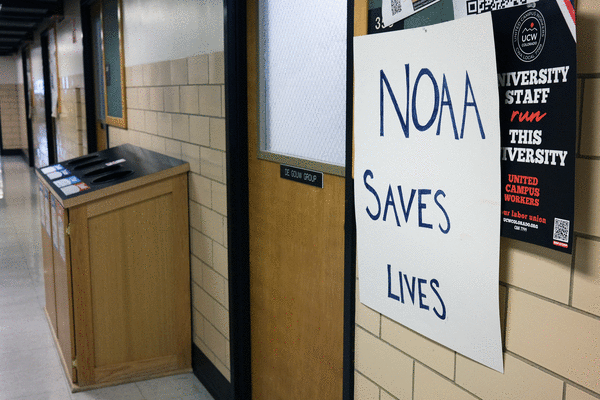
A fresh attack on the U.S. scientific infrastructure could be the most damaging yet.
The Trump administration is pushing alarming changes to rules that govern how federal agencies like the National Institutes of Health distribute funding — changes that threaten to permanently politicize research in the U.S. And since the NIH is the largest funder of biomedical research in the world, this could be bad news for everybody’s health.
The new rules were proposed by the Office of Management and Budget under the guise of improving accountability and transparency and reversing what it calls the previously “woke” research agenda. In reality, they would subvert the longstanding process for spending taxpayer money on research.
The changes are subtle, but the implications are massive. They would allow political appointees rather than subject-matter experts to have the final say over grant approval — and make it clear that funds could be pulled at any time. That could chill the very academic freedom that the administration claims to be working to restore.
“This is a five-alarm fire,” Carolyn Bertozzi, a Stanford chemical biologist who won the 2022 Nobel Prize in chemistry, said on a recent webinar hosted by the nonprofit Stand Up for Science.
The U.S. research infrastructure has endured sustained attacks from almost the moment Trump was sworn in for his second term. That began with a funding freeze that harmed academic labs’ ability to maintain research activities and even pay staff. Subsequent weeks brought cuts to funding that supports universities’ research infrastructure and the abrupt termination of grants deemed in violation of Trump’s executive orders on race and gender.
At the NIH, mass layoffs coinciding with increased political scrutiny have hampered the distribution of money Congress had appropriated for research. Meanwhile, the White House tried to slash the agency’s 2026 budget by 40%.
Time and again, many of the efforts to undercut the critical work of the NIH were rejected by the courts and lawmakers. And time and again, OMB director Russell Vought keeps coming up with new ways to damage U.S. science.
Vought’s latest attack is less visible than the earlier ones, but potentially more sinister. A more-than-400-page document outlining new proposed regulations emphasizes that peer reviewers, the panel of experts who weigh the merits of grant proposals, are merely advisers — and gives political appointees the power to veto funding if it runs counter to presidential priorities. Existing grants, meanwhile, can be terminated at the whims of the administration. (Before last year's chaos, grant terminations were exceedingly rare and due to problems with the work itself, not ideology.)
The whole effort turns the country’s vast research enterprise into a political playground, one where support for a particular project or prioritization of a particular disease might only last as long as an election cycle.
The repercussions could be devastating. America’s dominance in science depends on its willingness to invest in ambitious ideas — and on its researchers’ fearlessness in pursuing questions that might take years or even decades to answer.
It’s hard not to imagine that ambition being dimmed by the constant threat of shifting political priorities. Innovation in the U.S. “is likely to be massively curtailed,” says Shobita Parthasarathy, director of the University of Michigan’s Science, Technology and Public Policy Program. “You’re in a place where every four years, you’re totally changing directions, which is not the way science works.”
That would have real consequences for Americans’ health in the form of discoveries delayed or never even pursued — in the U.S., at least.
Vought’s moves also raise the risk of corruption and outside groups inappropriately influencing funding decisions. Trump has already shown an alarming comfort with using other HHS agencies to further his political agenda — for example, special vouchers promising speedy product reviews were reportedly used to reward companies that signed onto his drug pricing scheme.
The risk is “even less transparent and accountable decision-making,” says Parthasarathy. It opens the door for political appointees to “be influenced by the most powerful external stakeholders today: the leaders of the Big Tech companies,” she adds.
Meanwhile, universities and institutions, fearful of losing vital funds, are likely to become even more cautious, lest they appear to defy the administration’s agenda. The examples are already there: Recently, prominent physicians were kicked out of the American Diabetes Association conference for peacefully handing out an editorial criticizing the attacks on science — an editorial that had run in the ADA’s own flagship journal.
To be clear, none of this is to suggest that U.S. science lives outside the realm of politics. Each year, Congress apportions funds to individual institutes within NIH based on what lawmakers deem most critical to the public. Presidents, too, have had their say, in rare cases putting boundaries on certain areas of science. Lobbyists of all stripes try to influence it.
But the people tasked with deciding where those dollars are directed have always been the experts. The process isn’t perfect, but improving it is a matter of refinement — not blowing it all up.
____
This column reflects the personal views of the author and does not necessarily reflect the opinion of the editorial board or Bloomberg LP and its owners.
Lisa Jarvis is a Bloomberg Opinion columnist covering biotech, health care and the pharmaceutical industry. Previously, she was executive editor of Chemical & Engineering News.
©2026 Bloomberg L.P. Visit bloomberg.com/opinion. Distributed by Tribune Content Agency, LLC.










































Comments