Kaitlyn Buss: America is getting richer. Are Americans getting richer, too?
Published in Op Eds
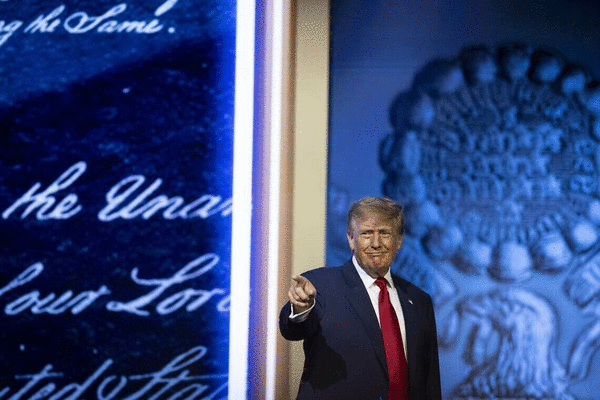
If Americans are getting so rich, why does President Donald Trump think they need a $5,000 dividend?
That’s the contradiction at the center of Republicans’ economic message with the November midterms seven weeks away.
Trump says the economy is booming. Yet last week he promised a $5,000 “Trump dividend” to every American adult citizen if Republicans maintain control of Congress. The proposal would require congressional approval and could cost more than $1.23 trillion.
Why would an economy delivering extraordinary prosperity need to put $5,000 directly into Americans’ bank accounts?
Because America getting richer and Americans getting richer are increasingly different things. And this election is about control — and what Americans can get from a federal government they’re struggling to trust.
“I do think it’s that question of who gets to control what, that’s at the heart of it,” Democratic U.S. Senate candidate Abdul El-Sayed told The Washington Post last week regarding data centers, artificial technology and where the wealth created by new technology goes.
Republicans are talking about control, too. The national GOP’s convention message coming out of the party's Dallas convention last week was focused again on working-class economic populism — with candidates pitching tax cuts, refunds, savings accounts and now direct payments.
These are all policies intended to make national economic gains tangible at the household level.
Trump’s answer to the same underlying anxiety is different from El-Sayed’s. El-Sayed is arguing for greater government power over economic decisions and the deployment of AI infrastructure. Trump’s answer includes tariffs, immigration restrictions, industrial policy, "trust" that guardrails around AI exist — and now a $5,000 check.
Those are vastly different policies in response to the same problem.
Republicans, including Trump, are trying to remind voters that the Biden administration’s pandemic-era spending turbocharged the inflation that followed. But Americans don't seem to be blaming Democrats for the mess of higher prices they're in today.
Americans increasingly feel they have lost control of the country they inhabit — including the economy they fuel.
The latest Bureau of Labor Statistics numbers capture the disconnect. Labor’s share of U.S. business output fell to 52.8% in the second quarter, the lowest level in a series dating to 1947. Real hourly compensation fell 0.1% over the previous four quarters, even as labor productivity increased 2.2%.
America is producing more, but workers aren’t necessarily capturing more of the gains.
Look at Oracle.
The technology giant reported a 30% increase in quarterly revenue last week and now has a $664 billion remaining performance obligation, driven heavily by demand for AI cloud computing. Oracle says demand for AI cloud training and inferencing services is growing faster than supply.
But it began another round of layoffs on Monday, Sept. 14, the size of which has not been disclosed. The company's workforce already shrank by roughly 21,000 employees, or 13%, in the fiscal year ending in May.
The problem, being borne out in politics, is that that wealth is not translating to people, voters.
A data center can represent billions in investment without employing thousands of people permanently. A corporation can become more productive while reducing its workforce. GDP, profits and stock prices can rise without giving the average American worker substantially more purchasing power.
But voters can’t spend GDP. They experience the economy through their paycheck, mortgage, grocery bill and whether their grown kids can afford a house.
That is where they are struggling, and why the politics of control has become so potent.
Trump’s proposed check may be the clearest illustration of the problem: Economic growth is not enough if Americans don’t feel they are participating in it.
But the economic question of the AI era is no longer simply whether America will get richer. It’s whether Americans themselves will get richer — and whether they will feel they have any control over the wealth their work and lives help create.
_____
©2026 www.detroitnews.com. Visit at detroitnews.com. Distributed by Tribune Content Agency, LLC.















































Comments