Fatal Air India Boeing 787 crash hits 1-year mark without final report
Published in Business News
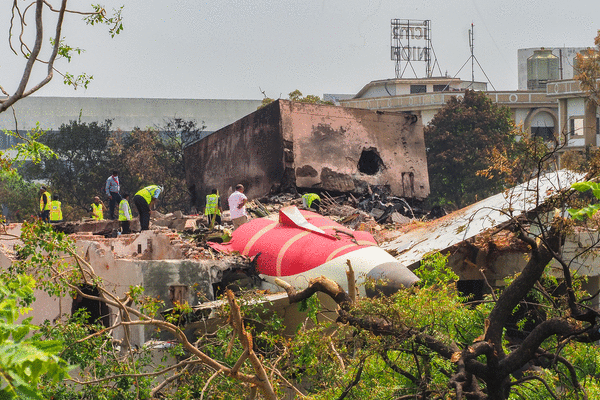
One year after an Air India Boeing 787 plane crashed just seconds after takeoff, hitting a nearby medical building and killing 260 people, investigators still have few answers about what went wrong.
India’s Aircraft Accident Investigation Bureau said Friday it is continuing to analyze evidence and will seek additional evaluations and examinations “wherever considered necessary.” It will release a final report, which should shed more light on what circumstances led to the fatal crash, once it has completed its investigation.
Following international standards for aviation disasters, investigators are expected to release a final report within one year of the crash. If they cannot do so, they must publish an update on the investigation.
“Over the past year, the investigation team has undertaken an extensive and rigorous examination of all relevant technical, operational, organisational and human factors associated with the accident,” the AAIB said in a statement.
“Significant progress has been made in the examination and analysis of aircraft systems, flight recorder data, engine-related components, maintenance and operational records and other evidence related to the investigation,” the group said.
Additional work will “continue to be undertaken to ensure that all findings and conclusions are supported by verified evidence and sound scientific analysis,” the AAIB said.
The Boeing 787 plane crashed in the northwestern Indian city of Ahmedabad on June 12, 2025, less than a minute after takeoff, killing 241 of the 242 people on board and 19 people on the ground.
Since then, the families who lost loved ones in the crash, pilots in the region and the flying public have been searching for answers. Investigators said in a preliminary report released in July that the plane’s two engines shut down within a second of each other, but it's still unclear what led to that situation.
Some former accident investigators and others in the aerospace industry speculated whether the captain, who was monitoring the flight while the first officer flew, had accidentally or intentionally cut fuel to the engines using two switches in the cockpit.
That theory has outraged the captain’s family, as well as the union representing pilots in India. Others in the aerospace industry have called for investigators to look more closely at the possibility of a manufacturing or electrical problem with the plane.
Aviation authorities in India and the U.S., including the National Transportation Safety Board, which is supporting India's AAIB in the investigation, have cautioned observers not to jump to conclusions based on preliminary information. India’s AAIB echoed that call on Friday.
“The sole purpose of an accident investigation is to enhance aviation safety through the identification of lessons and safety recommendations, and not to apportion blame or liability,” the bureau wrote in its statement. “Every aspect of the accident will be examined with the utmost care and diligence.”
The preliminary report found that two engine-fuel control switches, which start and stop the flow of fuel, had transitioned from the “run” to the “cutoff” setting within one second of the other. That deprived the engines of fuel, preventing the plane from being able to lift off.
In the recovered cockpit voice recording, one pilot is heard asking the other why he cut fuel to the engine. The other pilot responds that he had not. Soon after, the switches were turned back to “run” and one engine began to regain thrust, but it wasn’t enough to stop the plane from crashing.
The preliminary report did not find any recommended actions for Boeing, which manufactures the 787, or General Electric, the engine maker.
In a statement on Friday, Boeing said “Our thoughts remain with the families and loved ones who lost their lives on Flight 171, and with Air India and everyone affected by this tragedy. We continue to support the investigation.”
The crash was the first fatal disaster involving a Boeing 787 Dreamliner, the jetmaker’s smaller widebody plane. Boeing now manufactures the 787 in South Carolina, but the Air India 787 that crashed, one of Boeing’s first 787s, was built in Everett.
For the families who lost loved ones in the crash, the lack of clear information has been frustrating, said Stewarts, a UK-based law firm representing some of those families. The flight, headed toward London, had several UK citizens on board.
“A year on, bereaved families are still seeking clear answers about how and why this disaster occurred,” the law firm said in a statement Friday. “For them, understanding the technical causes is only part of what is needed. Accountability, transparency and preventing future loss of life remain essential.”
©2026 The Seattle Times. Visit seattletimes.com. Distributed by Tribune Content Agency, LLC.










Comments