UAW gathers in Detroit as Fain faces challengers, scrutiny
Published in Business News
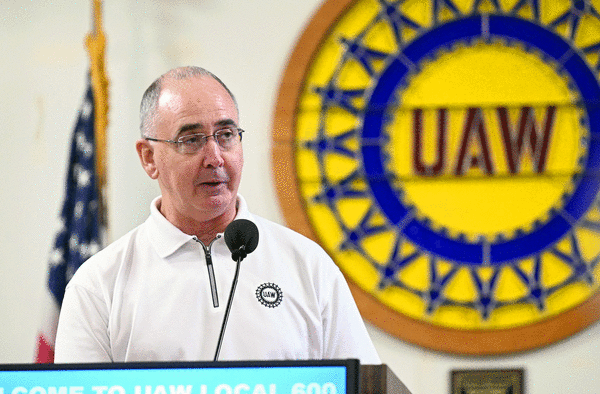
Nearly 1,000 United Auto Workers members arrive in downtown Detroit next week to chart the future of one the nation’s largest and most influential unions and nominate candidates for leadership elections later this year — including challengers to President Shawn Fain.
Beyond the leadership nominations, several big policy debates are brewing for the quadrennial UAW constitutional convention that runs Monday through Thursday. They include whether to increase strike pay for workers; whether to reduce member dues as the union's strike fund surges to $850 million; how much to spend on organizing new workplaces in the coming years, and even questions around who qualifies as a member.
The delegates elected from their union locals come from around the United States, including Puerto Rico, as well as Canada to debate various policy resolutions and proposed constitutional amendments and finalize which candidates will be on ballots set to be mailed out in late August.
The UAW's leaders for decades were picked by the delegates at the convention, but now — following reforms approved after the union's corruption scandal — they are directly voted upon by the union's approximately 400,000 active members and 600,000 retirees. That means those planning to run for one of the union's 14 International Executive Board seats need to secure a single nomination at the convention and then clear a vetting process.
The gathering comes at a critical juncture for a union still trying to shake off the bribery scandal that sent two former presidents to prison and put the union under federal monitorship. Fain and other senior union officials continue to face harsh criticism from that court-appointed monitor, lawyer Neil Barofsky, over internal dysfunction such as retaliation against certain employees and a lack of transparency. Many inside the union expect yet another critical report by Barofsky to be published shortly.
Fain draws challengers, including Boyer
Still, Fain remains the dominant figure at the head of the UAW with national name recognition. He's lost support in some corners of the union and grappled with a recall campaign that took root at several locals last year, yet no big names have announced campaigns to challenge him.
One prominent Fain rival, Vice President Rich Boyer, is preparing to launch a last-minute presidential campaign during the convention, however. And four other members who have already announced presidential runs and will seek nominations could also make a surprise push. They include Brian Keller, a Michigan Stellantis NV worker; Will Lehman, a Mack Trucks Inc. worker from Pennsylvania; Tricia Geiger, an Ohio-based UAW international servicing representative; and Greg Mooney, who works at tank-maker General Dynamics Land Systems in Ohio.
More: Shawn Fain faces 4 rivals in the UAW president race. Here's the list
Art Wheaton, director of labor studies at Cornell University, said Fain stands a strong chance of reelection when ballots are counted in October. Fain can point to key contract wins during his tenure, like the historic Detroit Three deals secured in 2023, or even more recently a victory for striking American Axle workers in southwest Michigan. He can also point to successful organizing drives, like at a Volkswagen AG plant in Tennessee and in higher education.
Wheaton said that although the monitor's reports have raised concerns about Fain's leadership and behavior leading the union, there has not yet been a "smoking gun" or criminal issue that would prevent him from running for another term.
The convention may be an ideal opportunity for Fain to talk in more detail about the UAW's stance toward the Trump administration and how best to retain union jobs in the United States: "A little more clarity on trade policy would be helpful for him," Wheaton said.
Fain has assembled a group of 12 officer and regional director candidates he's running with called the "Stand Up Slate," a riff on the union's "Stand Up Strike" against the Detroit Three in 2023.
But many other prominent names are running for other top roles and will be making their case at the convention. They include current Secretary-Treasurer Margaret Mock, and current Vice President Mike Booth, both of whom ran alongside Fain four years ago but were left off his slate this time.
Direct elections, strike pay up for debate
JoAnna McClenathan, a delegate from Local 571 in Connecticut, said she plans to back Fain as well as her region's current director, Brandon Mancilla.
But she's more focused on the union retaining its one-member, one-vote election system in general. The caucus she belongs to, UAW Member Action, is advocating an amendment that would make it tougher to switch back to the old delegate election system.
“A lot of our membership, it’s important to them that we maintain access to having a vote, to have a say in who our UAW leadership is," said McClenathan, who works at General Dynamics Electric Boat designing the U.S. Navy's nuclear submarines.
McClenathan said delegates also need to sort out who qualifies as a retiree in the union, an issue that some officials said could impact who can vote in the upcoming election. And the 42-year-old also favors raising strike pay to $625 per week from $500 now, a move that would have helped her colleagues have more confidence in walking out when they were facing contentious contract talks with Electric Boat last year.
"For a lot of our members, having a higher strike benefit would have made them more comfortable with the idea of a strike,” McClenathan said, noting the high cost of living in her part of Connecticut.
Union officials said they expect a debate over whether to cut union dues to 2 hours per week of pay, from 2.5, given the strike fund has grown so large. Other discussions are likely to center on organizing new workplaces, and whether some of those battles are worth the hefty price tag.
Reuther Caucus fades away in Fain era
The union's internal politics have shifted dramatically in the last few years. For decades, the union and its constitutional conventions were controlled by the Administration Caucus, founded by legendary UAW President Walter Reuther.
The group largely handpicked who held senior positions inside the union for 70 years and dictated major policy changes.
Even four years ago, the Administration Caucus remained the dominant political force inside the union. But with the election of Fain, who upset the incumbent Reuther-backed Ray Curry in the first direct elections four years ago, the caucus has fallen apart, officials say, and it no longer regularly meets. Several prominent former Administration Caucus-backed candidates, including current Vice President Laura Dickerson, have now joined Fain on his Stand-Up Slate.
Other alliances have fallen apart since the last big UAW gathering. Unite All Workers for Democracy, or UAWD, was a reform-minded group inside the union born out of frustrations about the corruption scandal. It was a key advocate for direct leadership elections and helped support Fain in his winning campaign.
The group, however, dissolved in 2024 over disagreements on the focus, purpose and future direction of the caucus. It split into two new groups: a new Unite All Workers for Democracy and UAW Member Action.
Member Action has laid out several policy priorities ahead of the convention and will meet to decide its candidate endorsements before the meetings begin, though the group is already expected to be a key backer of Fain and his slate.
“President Fain has brought about change to the UAW beyond my wildest dreams,” said Scott Houldieson, the chair of the group and an electrician at Ford Motor Co.'s Chicago Assembly Plant.
He pointed to Fain's moves to publicly discuss offers on the table during the 2023 talks with the Detroit Three and other steps to build contract campaigns before deals expired: “Those things have led to improved contracts across the board, and I think it's imperative that that be continued, so that we can continue to build worker power.”
The new UAWD, meanwhile, has now turned more critical of Fain. It is prioritizing issues such as more aggressive strike campaigns and aligning contract dates across the labor movement and different sectors to create more impact. Andrew Bergman, a co-chair of the group, said Fain is the most militant president the UAW has seen in a long time, and has spoken about a number of the issues important to the group.
But he hasn't gone far enough, said Bergman: “In theory, I think Fain is pretty close to a lot of these things, but then it's a little bit more about his rhetoric not matching his actions. He’s called for some of these things, but then he's had three years to do them and hasn’t.”
And there are other signs of political unrest inside the union, as well as dissatisfaction with the current leadership. A group of local presidents recently started meeting on their own to discuss policy priorities and what is in members' best interests, and help train up their newly-elected colleagues, said Tony Totty, who started the new Presidents' Council and leads UAW Local 14 in Toledo. The group has about 80 members.
"Hopefully, that will provide some of the stability that we need," Totty said of the group.
©2026 www.detroitnews.com. Visit at detroitnews.com. Distributed by Tribune Content Agency, LLC.

Comments